
Pragmatically Communicating: How to talk BMX

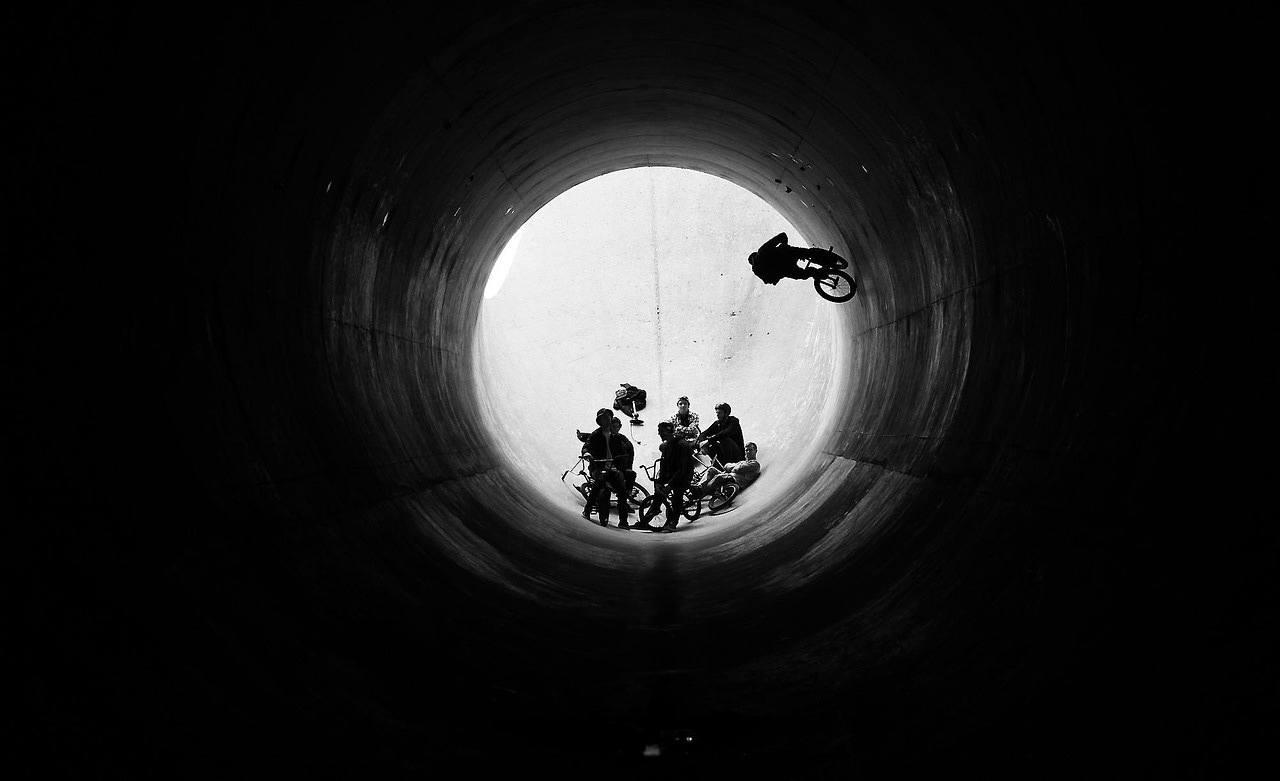
BMX is more than just a sport; it is a deeply expressive and communicative practice, blending athleticism with creativity. Riders engage in BMX not merely to land tricks but to convey personal style, challenge conventions, and interact with their environment in a way that extends beyond mere movement. To fully appreciate BMX, one must look beyond its physical aspects and consider how meaning is constructed within the sport. The philosophy of pragmatics, which studies how context influences meaning and communication, offers a compelling lens through which to analyse BMX.
Pragmatics examines how individuals interpret and convey messages based on context, intention, and social interaction. Today we will look at how BMX embodies principles of pragmatics, from the performative aspects of tricks to the nuanced ways riders communicate with each other and their surroundings.
BMX as a Form of Nonverbal Communication
At its core, pragmatics deals with the ways people derive meaning from communication beyond mere words. BMX operates similarly, relying on nonverbal cues such as body movements, trick execution, and spatial awareness. Just as spoken language relies on pragmatics to convey meaning that might not be explicitly stated, BMX depends on riders’ choices to create a shared understanding within the BMX community.
For example, when a rider lands a tailwhip with effortless style, it communicates more than technical skill—it signals creativity, control, and an engagement with the aesthetic values of the sport. The way a trick is performed, the flow between tricks, and even the choice of terrain all contribute to the expressive dimension of BMX. These elements function much like intonation and body language in spoken communication, influencing how an audience perceives a rider’s performance.
Context and Interpretation in BMX
Pragmatics emphasises the importance of context in shaping meaning, and BMX is inherently contextual. The same trick performed in different environments can have distinct implications. For instance, landing a flair in a well-maintained skatepark with purpose-built ramps differs significantly from performing it on an urban structure such as transitioned brick wall. The latter might be interpreted as a statement of rebellion or ingenuity, showcasing the rider’s ability to adapt their skills to unconventional settings.
Additionally, context extends to the social environment. In a competition setting, a rider might perform tricks designed to score highly based on judges’ criteria, whereas in a street riding video, the focus may be on originality, creativity, and risk-taking. These contextual variations align with the pragmatic principle that meaning is shaped by the interaction between the communicator (rider) and the audience (judges, fellow riders, or viewers).
Implicature and BMX Trick Sequences
Implicature, a key concept in pragmatics, refers to the idea that meaning is often implied rather than explicitly stated. In BMX, riders construct sequences of tricks that imply specific messages or intentions. A well-constructed line—where tricks flow seamlessly into one another—suggests a mastery of control and an intuitive understanding of movement. Conversely, a hesitant or disjointed sequence may indicate a lack of confidence or difficulty with a particular trick.
Riders also use implicature when responding to challenges or interacting with peers. For example, in a game of B.I.K.E., where riders take turns setting tricks for others to replicate, choosing a particularly complex or unconventional trick may imply a challenge beyond the explicit expectation of mere replication. This nonverbal communication relies on a shared understanding of the sport’s norms and expectations, much like conversational implicature in spoken language.
Pragmatic Strategies in BMX
Several pragmatic strategies are evident in BMX, including:
Code-Switching Between Environments – Just as bilingual individuals switch between languages based on context, BMX riders adapt their style depending on the setting. A rider who excels in dirt jumps may shift their approach when riding street spots, modifying their trick selection to align with the constraints and possibilities of urban terrain.
Conventionalised Signals – BMX riders use body language and subtle cues to communicate while riding. A nod or a specific hand gesture can indicate readiness to drop into a bowl or request space from fellow riders. These signals function as pragmatic conventions within the BMX community.
Repair Mechanisms in Trick Execution – Similar to how speakers correct themselves in conversation, riders employ adaptive techniques to recover from missteps mid-trick. For instance, if a rider under-rotates a 360, they may shift their weight to adjust their landing. This ability to ‘repair’ a trick reflects the pragmatic concept of conversational repair, where speakers adjust their statements to maintain coherence and understanding.
BMX as a Dialogue with the Environment
Another fundamental aspect of pragmatics is deixis—the use of context-dependent references. In BMX, riders engage in a form of spatial deixis, interacting dynamically with their environment. A handrail, for example, is not merely an object but an invitation for a grind or a gap. The meaning of urban structures shifts based on how riders engage with them, much like how words acquire different meanings depending on context.
This interplay between rider and environment can be viewed as a dialogue, where each trick ‘responds’ to the architecture in unique ways. A rider choosing to wall-ride a vertical surface instead of simply jumping past it transforms the function of that structure, reinterpreting space in ways that align with the pragmatic principle of contextual meaning-making.
Convesing with the world
Pragmatics provides a valuable framework for understanding BMX as a complex and context-dependent form of communication. Just as pragmatics reveals the underlying structures of human language, it also illuminates how BMX riders construct meaning through tricks, sequences, and interactions with their environment. By examining BMX through a pragmatic lens, we appreciate its depth beyond physical performance, recognising it as an intricate language of movement, creativity, and cultural expression.
Ultimately, BMX is more than an individual pursuit—it is a shared dialogue between riders, spectators, and the built environment.